

Maternity Support Belt
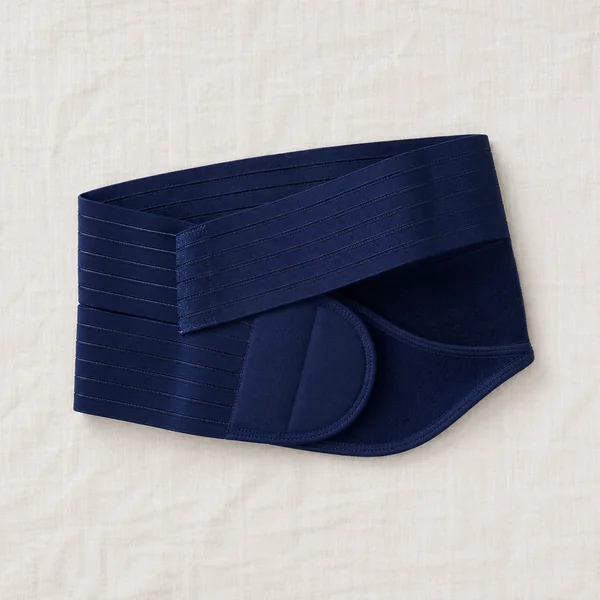
Measure your waist low, under the bump — not at your usual waistband.
What it does, and the hours it does nothing
The mechanics are simple and worth knowing before you choose a size. A bump pulls forward and down. A belt placed under it takes part of that load and passes it to the hip bones, which are built to carry weight. Nothing is held up by magic: the weight moves from one place to another.
That also sets its limits. Lying down, gravity is no longer pulling the bump forward, so the belt has nothing to transfer — it is a daytime object. For the nights, the equivalent tool is a U-shaped pregnancy pillow, which is why the two are sold together below. Our guide on what a support belt does goes through it in detail.
The four sizes
| Size | Waist, measured low under the bump |
|---|---|
| M | waist 27.5 to 39 in (70–100 cm) |
| L | waist 31.5 to 43 in (80–110 cm) |
| XL | waist 35.5 to 47 in (90–120 cm) |
| XXL | waist 39.5 to 51 in (100–130 cm) |
⚠️ Measure yourself rather than guessing from a clothing size. A belt is worn lower than a waistband, and the wrong size is worse than none: too loose it carries nothing, too tight it stops being a support.
Three things that decide whether it works
- Low, under the bump — not across it. Over the bump it compresses instead of carrying.
- Tightened standing up. A belt set while seated is loose the moment you stand.
- Refastened every few weeks, because your bump changes and the tension has to follow.
Most of the disappointment with these belts comes from those three points rather than from the belt itself. Our guide on how to wear one shows the placement.
Belt, band, or pelvic support?
Three different objects that photograph alike. A support belt carries weight. A belly band is a stretch tube that covers the gap in your clothes. A pelvic belt is narrower, sits lower, and is normally fitted by a midwife or physiotherapist.
We sell the first. The guides cover belt or band, how to choose one, when to start and pelvic support belts.
Common questions
What does a maternity support belt actually do?
It carries part of the weight of your bump through your hips instead of leaving it pulling forward. That is a mechanical transfer, and it happens only while you are upright — a belt does nothing lying down, which is why it is a daytime object.
Which size should I take?
Measure your waist low, under the bump, and read it off the table on this page. Do not go by your usual clothing size: a support belt sits lower than a waistband, and that measurement is not the one on your jeans. Our four sizes cover 27.5 to 51 inches.
When should I start wearing it?
There is no week that decides it. Most women reach for one when standing still starts costing them something — often in the second half of the pregnancy. Our guide on when to start goes through the signs.
How long can I wear it in a day?
It is made for stretches of activity rather than continuous wear: put it on for the hours you are on your feet, take it off when you sit down for a while. If anything feels uncomfortable, that is a reason to loosen it or take it off, and to ask your midwife.
Can I wear it after the birth?
It is shaped to sit under a bump and carry its weight, which is a job that ends when the bump does. Most women stop at the birth. A postpartum wrap is a different object with a different job — our guide goes through it.
What if it does not suit me?
You have 30 days to change your mind. See our returns policy.

Maeve Sutton · Editorial lead at The Pregnancy Pillow
Maeve goes through buyer feedback before a model ever gets a page: she reads the reviews one by one, opens every photo customers send in, and holds what the description promises against what they actually received. That is the work that showed three of the four colour names described a different fabric. She writes the guides on this site.